Receive requirement
Review the equipment, fluid type, operating concern and requested test parameters.
ORDNEX coordinates lubricating oil, hydraulic oil, fuel, cooling water and condition-monitoring analysis through qualified UAE laboratory partners for marine, defence-support and industrial assets.
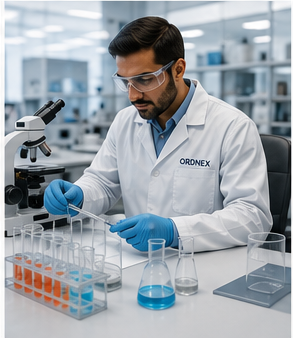
From sample-bottle selection and extraction guidance through laboratory routing and final reporting, ORDNEX manages each stage with traceable communication and a clear technical focus.
Select a service to review common test parameters, applications, sampling guidance and technical reporting scope.
Condition monitoring for main engines, gearboxes and rotating machinery. Detects wear metals, oil degradation and water ingress before failures develop.
Contamination and cleanliness assessment for hydraulic circuits, steering gear, CPP systems and deck machinery, including ISO 4406 reporting.
Quality testing for bunkering verification and MARPOL sulphur compliance across MGO, HFO, VLSFO and diesel fuels.
Chemistry monitoring for jacket water, freshwater cooling loops and HVAC systems to identify scale, corrosion and inhibitor imbalance.
Feed-water and boiler-water chemistry for auxiliary boilers, economisers and steam systems, with suitable reporting for technical review.
ICP spectrometric analysis mapping metal particles in oil to likely machine components for early identification of developing wear.
Condition assessment for deck machinery pins, slew-ring bearings, open gears and CPP blade-root seals, including thickener identification.
Dielectric-fluid testing, including dissolved gas analysis, to identify thermal faults, partial discharge and arcing conditions.
ISO 4406 particle-count assessment quantifying contamination at key size thresholds and confirming fluid cleanliness condition.
Four controlled stages connect the technical requirement with sample handling, laboratory analysis and final report delivery.
Review the equipment, fluid type, operating concern and requested test parameters.
Confirm suitable bottles, extraction method, sample labelling and handling requirements.
Route the sample to a qualified UAE laboratory partner and coordinate the required analysis.
Deliver the laboratory report with clear technical interpretation and recommended follow-up.
ORDNEX coordinates testing through qualified UAE laboratory partners. Analysis is performed by the selected laboratory. ORDNEX manages technical coordination, reporting and customer communication. Turnaround times remain subject to laboratory capacity, sample condition and requested parameters.